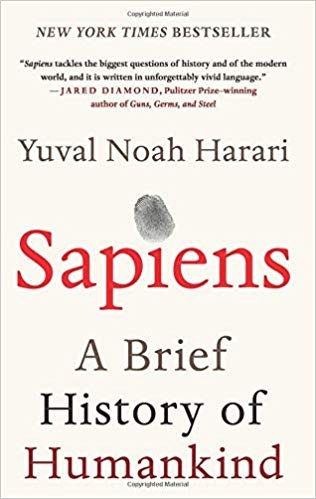
Sapiens
A Brief History of Humankind
by Yuval Noah Harari
Editorial review
Harari's bestseller is less a conventional history than a set of wide-angle arguments about how Homo sapiens came to dominate the planet — through shared fictions, agricultural traps, and the accelerating logic of empire and technology. Agree or disagree with every thesis; the book earns its place by forcing a coherent conversation about scale.
AI-generated summary
From the Cognitive Revolution through the Agricultural and Scientific Revolutions to the present, Harari narrates how myths, religions, money, and states coordinate mass cooperation — and asks what happiness and meaning might mean at the end of that arc.
Key takeaways
- 1
Large-scale cooperation depends on imagined orders — money, nations, human rights — not only on force.
- 2
Agriculture increased calories per land but not necessarily well-being per life.
- 3
Science, empire, and capitalism intertwined as a feedback loop in the modern world.
- 4
Happiness is partly biological expectation management, not only material progress.
The right reader
Readers who want one ambitious synthesis before diving into narrower histories. Pair with Jared Diamond or David Graeber for counterpoint.
What it touches
How it reads
Sweeping, provocative, readable.
Reading difficulty: Moderate


